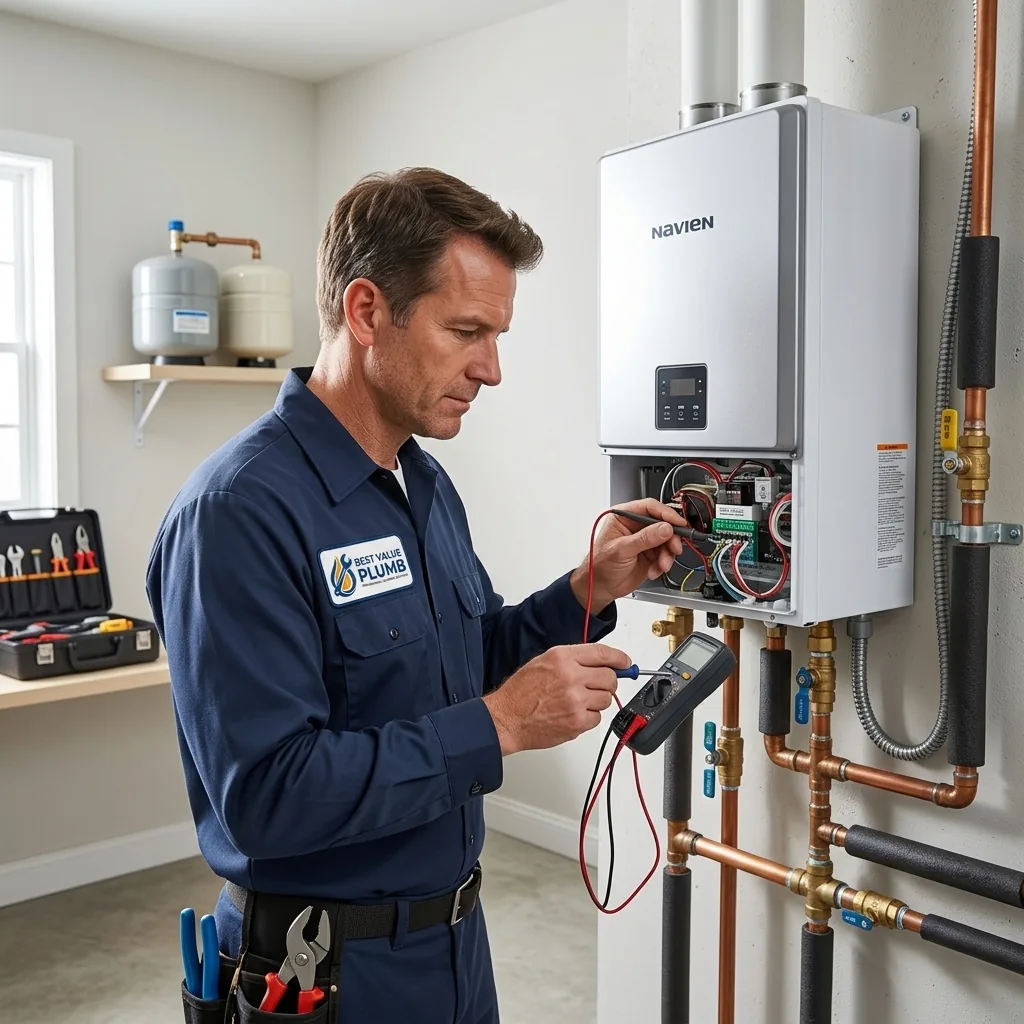
The tank vs tankless water heater debate in Florida has a twist: warm groundwater and high humidity change the math on both options. When your water heater starts rumbling, leaking, or simply running out of hot water halfway through a shower, you face a choice: replace it with another traditional tank unit, or make the switch to tankless. Both are solid options, and both are common in Florida homes — but they work very differently, and the right pick depends on your household, your budget, and how you use hot water.
This guide compares how each type works on the factors that matter — upfront cost, energy use, lifespan, capacity, space, and maintenance — so you can choose with confidence.
1. 🔥 How a Traditional Tank Water Heater Works
A tank water heater heats a large tank of water and keeps it hot around the clock, so hot water is ready whenever you turn on a tap. As you use hot water, cold water flows in to replace it, and the burner or heating elements bring it back up to temperature.
Tanks are simple and proven, but you pay to keep water hot even when nobody is home (standby loss), the supply is limited — run it out and you wait — and the unit takes up real floor space.
2. ♨️ How a Tankless (On-Demand) Water Heater Works
A tankless unit has no storage tank at all. When you open a hot-water tap, sensors detect the flow and powerful burners or electric elements heat the water as it passes through — delivering a continuous supply for as long as you need it. Close the tap, and the unit shuts down.
With no tank to keep hot, tankless units waste less standby energy and mount on a wall, freeing floor space. The trade-off is capacity: a unit can only heat so much water per minute, so if demand exceeds it — two showers plus the dishwasher, say — the temperature can drop.
3. 💰 Comparing Cost, Energy Use, and Lifespan
A traditional tank costs noticeably less to buy and install, especially as a like-for-like replacement. Tankless equipment costs more, and installation can be involved: gas models may need venting and gas-line upgrades, while electric models may need electrical work.
On running costs, tankless has the edge, since it heats water only when you need it instead of keeping a tank hot all day. On lifespan, tankless units generally last longer than tanks — provided they are maintained, which matters more in Florida (see below). Either way, a professional water heater replacement done right will give you the full life out of whichever type you choose.
4. 👨👩👧👦 Matching the Heater to Your Household
Think about your peak hot-water demand, not your average use. A one- or two-person household with staggered showers is easy to serve with either type. A busy family where two bathrooms, the dishwasher, and the laundry all run in the same hour needs serious capacity.
That means a large enough tank with fast recovery, or a tankless unit rated for your simultaneous flow. Be honest about your habits — undersizing is the most common tankless regret.
5. 🧂 Florida Hard Water Makes Maintenance Matter
Much of Florida has moderately hard to hard water, and mineral buildup is the enemy of every water heater. In tank units, sediment settles at the bottom, forcing longer heat cycles and eventually causing rumbling noises and premature failure — periodic flushing clears that sediment out.
Tankless units do not store water, but scale can coat their heat exchangers and choke performance fast in hard-water areas. They need periodic descaling — a professional flush with a descaling solution — to stay efficient. Skip this maintenance and even a premium tankless unit will underperform.
6. 🛠️ Installation Factors Worth Knowing
Switching from tank to tankless is not always a simple swap. Gas tankless units need proper venting and adequate gas supply; electric models draw a lot of power and may require panel upgrades. Placement matters too: the closer the unit sits to where hot water is used, the less water you waste waiting for it to arrive.
A good installer sorts these out during an in-home assessment. If aging supply lines need attention too, addressing pipe repairs in the same visit avoids paying for two projects.
Related reading: Water Heater Maintenance Tips — yearly habits that add years to either type of unit.
Frequently Asked Questions
Is a tankless water heater worth it in Florida?
It can be, especially for households that use a lot of hot water or want endless supply and space savings. The key is proper sizing and committing to regular descaling, since Florida hard water will shorten the life of a neglected tankless unit.
How long do tank and tankless water heaters last?
A traditional tank typically lasts around a decade or so with basic maintenance, while a well-maintained tankless unit can last significantly longer. Hard water, heavy use, and skipped maintenance shorten the life of both types.
Can a tankless water heater run out of hot water?
Not in the way a tank does, but it has a flow limit. If your household demands more hot water per minute than the unit can heat, the temperature will drop. Correct sizing for your peak demand prevents this.
Do I need an electrician or plumber to install a tankless unit?
A licensed plumber handles the water and gas connections, venting, and sizing. Depending on the model, electrical upgrades may also be needed. Best Value Plumb can assess your home and coordinate what the job requires.
Not Sure Which Water Heater to Choose?
Talk it through with a plumber who will give you an honest recommendation — not just the most expensive option. Call Best Value Plumb today and we will connect you with a local water heater pro for installation and replacement — ask about pricing before work begins.
📞 Call