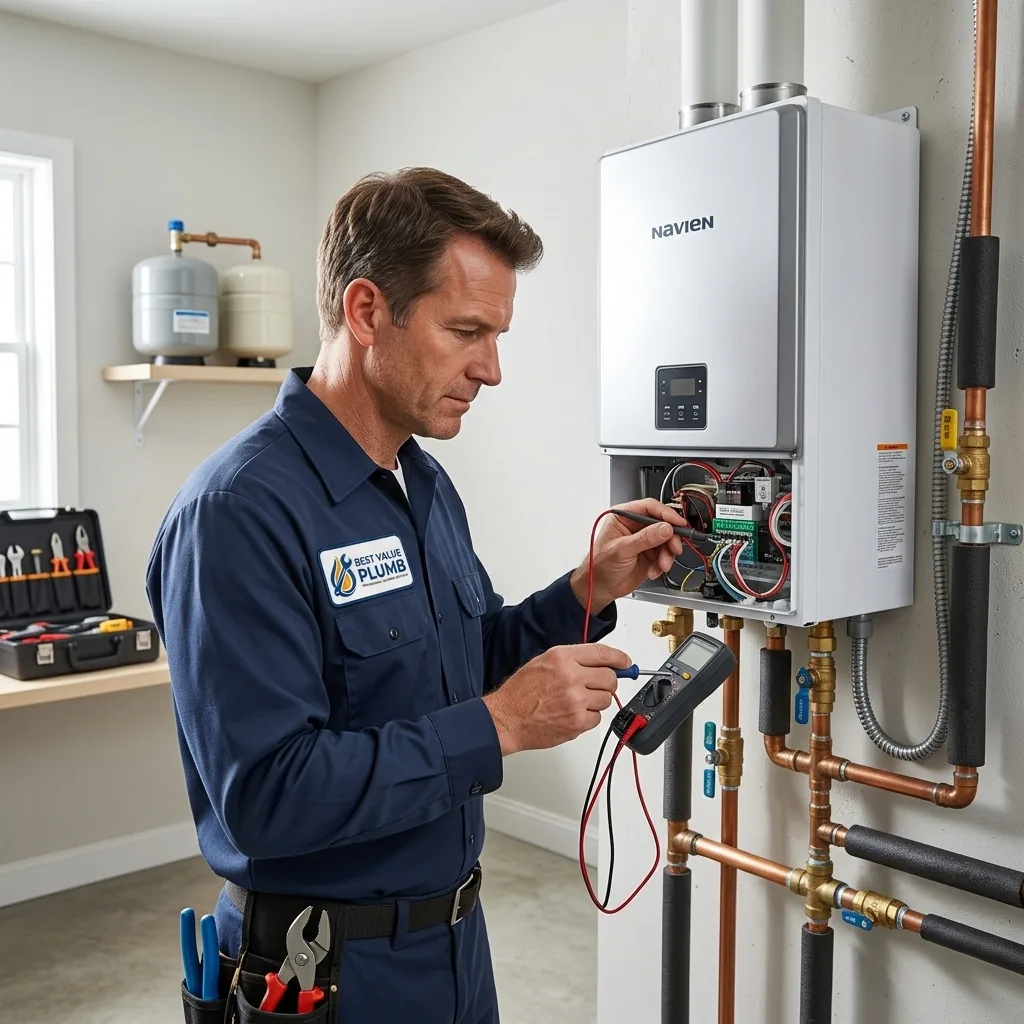
The shower runs hot for four minutes, then fades to lukewarm — the first sign you may need water heater repair in Pompano Beach, FL. Or you notice a rusty trickle under the water heater in the garage, and a faint metallic smell in the hot water. In Pompano Beach, where salt air drifts in off the Atlantic and hard water leaves sediment in every tank in town, water heater problems follow a predictable pattern — and most of them give you fair warning before they become emergencies. The question homeowners always ask is the right one: repair it, or replace it?
The answer comes down to age, the specific failure, and math. A standard tank lasts 8 to 12 years; repairs run $150 to $600 while replacement costs $1,200 to $2,800 installed. This guide covers the most common failures and their costs, the repair-versus-replace rule by age, what Pompano Beach's hard water and salt air do to your tank, condo and HOA considerations, Florida code requirements, and the maintenance habits that stretch a tank's life.
How Long Water Heaters Last in Pompano Beach
The national average lifespan for a tank water heater is 8 to 12 years, but local conditions push Pompano Beach tanks toward the shorter end unless they are maintained. Two forces work against them here.
First, hard water. Much of Broward County's supply runs moderately hard, and every heated gallon drops calcium carbonate as sediment. Over years it forms a blanket inches thick on the tank bottom — insulating the burner on gas units (forcing overheating burn cycles) and burying the lower element on electric units until it burns out, the most common electric failure in South Florida. An unflushed tank can lose 15 to 25 percent efficiency and two to four years of life.
Second, salt air. Airborne salt accelerates corrosion on the tank jacket, pipe connections, gas draft hoods, and relief valve piping — worst for units in outdoor closets or carports on the beach side, where pitted fittings and seized valves are common. See salt air corrosion on plumbing fixtures for the broader picture.
Find your tank's age from the serial number on the manufacturer's label. For most brands (Rheem, AO Smith, Bradford White), the digits after the letter prefix encode year and month — a serial starting 1611 means November 2016. If your tank is approaching year 10 without regular flushing, budget for replacement rather than major repairs.
Water Heater Repair in Pompano Beach, FL
This is the framework plumbers use, and it works:
- Under 6 years old: Almost always repair. The tank itself has years of life left, and most failures at this age are component failures — thermostats, elements, valves — covered partly or fully by the manufacturer's warranty (typically 6 years on the tank, 1 to 2 years on parts for standard models).
- 6 to 10 years old: Repair if the fix is minor (under $300) and the tank shows no internal corrosion — no rusty water, no sediment rumbling, no moisture at the base. Decline repairs over $400; hold that money toward replacement.
- Over 10 years old: Replace rather than repair, with one exception: a cheap external fix (a $150 thermostat or a $200 element) that buys a year or two while you plan the replacement on your schedule instead of in an emergency. Never spend $400+ repairing a tank past year 10.
- Any age with a leaking tank: Replace. A tank that leaks from the body — as opposed to a fitting, valve, or connection — has internal corrosion that cannot be repaired. No sealant, patch, or welding fixes a corroded tank; replacement is the only option.
The economics are straightforward: a $250 element on a 5-year-old tank buys roughly five more years (about $50 per year of extended life); the same $250 on an 11-year-old tank buys maybe one year. Emergency replacements cost 20 to 40 percent more than planned ones — after-hours rates, and whatever model is in stock. A tank past year 10 needing significant repair is telling you to schedule replacement now, on your terms.
Common Failures and What Each Costs to Fix
Most service calls on tank water heaters come down to five components. Here is what fails, why, and what the repair costs in the Pompano Beach market.
Heating elements (electric units) — $150 to $300
Electric tanks have two 4,500-watt elements; the lower does most of the work and fails first, usually from sediment burial or burnout after 6 to 10 years. Symptom: a few minutes of hot water, then lukewarm, because the upper element only heats the top third. A plumber tests each element with a multimeter, drains below the element port, and swaps in a new one — about an hour's work. If both are original and one failed, replacing both adds roughly $50 in parts and is worth doing while the tank is drained.
Thermostats (electric units) — $150 to $250
Each element has its own thermostat. A stuck-closed thermostat produces scalding water; stuck-open gives lukewarm. A failed upper thermostat can trip the high-limit reset button (the red button behind the upper access panel) — if you reset it more than once, the thermostat is failing. Replacement is quick, often done alongside an element swap.
Thermocouple and gas control valve (gas units) — $150 to $400
On gas heaters, a pilot that will not stay lit is almost always a failed thermocouple ($150 to $250 replaced). If the thermocouple is good but the burner will not fire, the gas control valve ($300 to $400) is the culprit. Gas work requires a licensed professional — no DIY. Any gas smell means leaving the area and calling the gas utility first, then a plumber.
TPR valve — $150 to $275
The TPR valve is the tank's critical safety device: it discharges water if temperature exceeds 210°F or pressure exceeds 150 PSI, preventing tank rupture. Intermittent discharge may mean it is doing its job against excessive pressure — the real problem being a failed expansion tank or incoming pressure over 80 PSI. Constant dripping at normal pressure means a fouled seat needing replacement. Never cap a dripping TPR valve. The discharge line must run downward to within 6 inches of the floor.
Anode rod — $200 to $350
The anode rod hangs inside the tank and corrodes sacrificially so the steel does not — it is why tanks last a decade instead of three years. In Pompano Beach's water, rods deplete in 3 to 5 years; once depleted, the tank itself starts corroding irreversibly. Replacing the rod on schedule ($200 to $350 with the service visit) is the highest-value maintenance a water heater receives. Rotten-egg smell means bacteria reacting with a magnesium anode — an aluminum-zinc rod ($30 to $60) usually solves it. Check at year 3 and every 2 years after; replace when 6+ inches of core wire shows.
Sediment: Pompano Beach's Slow Killer
Sediment is the background cause behind so many local failures. Pompano Beach's water lays it down faster than average, and symptoms creep up gradually enough that homeowners adapt instead of acting.
Popping or rumbling during heating is water trapped under sediment flashing to steam — the signature of a tank working too hard. If the shower goes cold faster than two years ago, sediment has displaced water volume and insulated the heat source. Once a year, open the drain valve briefly into a bucket: milky or gritty water means the tank needs flushing.
Flushing is a $150 to $250 service visit, or DIY: shut off power or gas, close the cold-water inlet, attach a hose to the drain valve, and flush until water runs clear — then briefly reopen the inlet to stir remaining sediment and flush again. On electric units, confirm power is off at the breaker before draining below the elements; a dry-fired element burns out in under a minute. If the tank was never flushed and is over 8 years old, have a plumber do the first flush — disturbing a decade of sediment can clog the valve or reveal a tank too far gone, and you want a professional present.
Condo and HOA Considerations in Pompano Beach
A large share of Pompano Beach homeowners live in beachside condos and HOA communities, where water heater replacement involves rules and logistics that single-family owners never face.
First, check your HOA's requirements before scheduling anything. Many associations require licensed and insured contractors, certificates of insurance naming the association, weekday-only work hours, and elevator reservations for moving tanks. Some mandate upgrades at replacement — expansion tanks, drain pans with dedicated drain lines, or seismic strapping. Get requirements in writing before the plumber arrives to avoid a rejected installation and a second trip charge.
Second, access and pans. Condo heaters often sit in tight interior closets with no floor drain, and Florida code requires a drain pan where a leak could cause damage — nearly every condo. No pan on the current tank means the replacement adds one ($100 to $200). Measure the closet before ordering: standard 50-gallon tanks run about 60 inches tall by 22 inches in diameter, and closet depth plus door swing eliminates some models. Lowboy models fit tight spaces at a modest premium.
Third, shutoff coordination. Many condo shutoffs sit in a common chase or need building maintenance to access. Loop the building's maintenance contact into the scheduling — a plumber who arrives but cannot shut off the water bills for the wasted trip.
Finally, leak liability: your water heater leak is your downstairs neighbor's ceiling damage. Past year 10, proactive replacement wins easily — a $1,500 planned replacement versus a $5,000+ neighbor damage claim and HOA fines. Some associations now mandate replacement at 10 years regardless of condition; check your documents.
Replacement Costs and Choosing the New Unit
Here is what Pompano Beach homeowners actually pay installed — unit, labor, permit, pan, expansion tank, and haul-away included:
- 40-gallon electric tank: $1,200 to $1,800 installed. The budget option for 1- to 2-person households.
- 50-gallon electric tank: $1,400 to $2,000 installed. The standard choice for 3- to 4-person households.
- 40- to 50-gallon gas tank: $1,600 to $2,400 installed. Higher upfront, lower operating cost where gas service exists.
- Tankless (whole-house): $2,500 to $4,500 installed, including the gas line upgrade or electrical panel work that tankless units usually require. Endless hot water and 20+ year lifespan, but the installation extras surprise many buyers — get the full installed quote, not the unit price.
Sizing matters more than brand: 50 gallons suits most 3- to 4-person households. Look for a Uniform Energy Factor (UEF) above 0.90 on electric tanks. Heat pump (hybrid) heaters at $2,000 to $3,200 installed cut water-heating energy 60 percent — compelling in Florida's warm garages — but need about 700 cubic feet of air space and run noisier than standard tanks.
The tank vs. tankless decision leans on usage: tankless suits high simultaneous demand and long ownership horizons; standard tanks win on simplicity and upfront cost. Either way, insist on a new brass full-port ball valve on the cold inlet, a thermal expansion tank (code-required on closed systems), and a pan with a drain line.
Florida Code Notes Worth Knowing
You do not need to memorize the code, but knowing what it requires helps you evaluate quotes — a bid that omits required items is not actually cheaper.
In Florida, replacements require a permit and inspection in virtually every jurisdiction, including Pompano Beach ($75 to $150, pulled by your plumber as part of the job). Key requirements: TPR valve with discharge piping terminating 6 inches above the floor, expansion tank on closed systems, drain pan with drainage where leaks could cause damage, proper combustion air and venting for gas (never into attics or crawlspaces), and an electrical disconnect within sight of electric units. Gas vent connectors must slope upward at least 1/4 inch per foot — back-pitched venting spills carbon monoxide indoors.
Switching fuel types or going tankless adds permits for gas line or panel work and a longer inspection timeline. Plan a full day for installation plus the inspection visit.
Maintenance Habits That Extend Tank Life
A water heater is not set-and-forget — at least not in Pompano Beach. Five habits, most annual, add years:
- Flush annually. As detailed above — the single most impactful habit in hard-water areas. Mark it on the calendar alongside the smoke detector batteries.
- Check the anode rod at year 3, then every 2 years. Replace when depleted. This is the tank's corrosion shield; without it, the tank is on borrowed time.
- Test the TPR valve yearly. Lift the lever briefly — water should flow, then stop cleanly when released. If it drips afterward or will not open, replace it.
- Check the expansion tank annually. Tap it — the top should sound hollow (air) and the bottom solid (water). If the whole tank sounds solid, the bladder failed and the tank is waterlogged; replace it ($150 to $250).
- Keep the area clear and dry. Do not store boxes against the tank — combustion air, heat-pump airflow, and visual leak-spotting all matter. Glance at the base monthly for moisture or rust streaks; catching a weep early means a planned replacement instead of a flood.
Water heaters fail on their own schedule — but in Pompano Beach, that schedule is heavily influenced by sediment, salt air, and maintenance. Know your tank's age, fix small failures promptly, flush and check the anode rod on schedule, and replace proactively rather than reactively in a puddle. The homeowners who spend the least over 20 years maintained the tank they had and replaced it on their own terms. For deeper upkeep routines, see water heater maintenance tips.
Frequently Asked Questions
Should I repair or replace my water heater?
Repair if the tank is under 10 years old, the fix costs under $300 to $400, and the tank shows no rust, leaks, or heavy sediment rumbling. Replace if the tank is over 10 years old, needs a repair over $400, or leaks from the tank body itself — a leaking tank can never be repaired. Standard tanks last 8 to 12 years, and replacement runs $1,200 to $2,800 installed.
Why does my shower go cold after just a few minutes?
A few minutes of hot water followed by lukewarm usually means a failed lower heating element on an electric unit ($150 to $300 to replace). Sediment burying the element is the most common cause in Pompano Beach's hard water. If the water is scalding or the high-limit reset button keeps tripping, suspect a failed thermostat ($150 to $250).
What causes the popping and rumbling noise in my water heater?
Popping or rumbling sounds mean water is trapped under a layer of sediment and flashing to steam — the tank is overheating its own bottom. Flush the tank annually to remove sediment buildup. If the tank is over 8 years old and has never been flushed, have a plumber do the first flush, since disturbing a decade of sediment can clog the drain valve.
How often should the anode rod be replaced?
In Pompano Beach's water, anode rods typically deplete in 3 to 5 years. Check the rod at year 3 and every 2 years after; replace it when more than 6 inches of core wire is exposed ($200 to $350 including the service visit). The rod corrodes sacrificially to protect the steel tank — without it, the tank itself starts corroding, which cannot be reversed.
Do I need a permit to replace a water heater in Pompano Beach?
Yes — replacements require a permit and inspection in Pompano Beach ($75 to $150, handled by your plumber). Code requires a TPR valve with proper discharge piping, an expansion tank on closed systems, a drain pan with drainage where leaks could cause damage, and proper venting for gas units. Quotes that omit these items are not actually cheaper.
What should condo owners know about water heater replacement?
Check your HOA's contractor, insurance, and work-hour requirements first, and confirm elevator reservations if needed. Condos often need a drain pan with a dedicated drain line, and tight closets may require lowboy models — measure before ordering. Coordinate the water shutoff with building maintenance, and note that some associations mandate replacement at 10 years regardless of condition.
No Hot Water? We Fix It Fast in Pompano Beach
From a $150 thermostat swap to full replacement, our licensed plumbers diagnose your water heater the same day and give you straight repair-vs-replace math — no pressure, no guesswork.
📞 Call +1 (850) 904-1147